
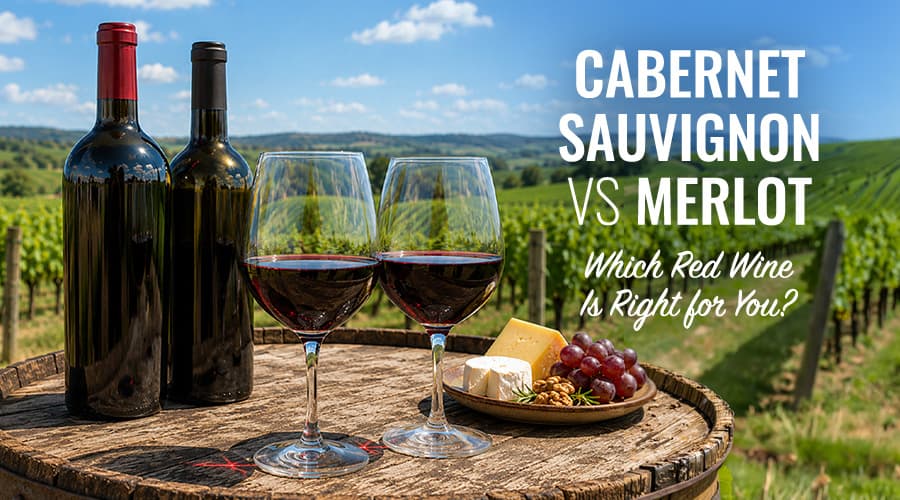
Cabernet Sauvignon vs Merlot - Which Red Wine Is Right for You?
Estimated Reading Time: 11 Minutes
If you're wondering about the difference, think of Cabernet Sauvignon as the bold, structured choice, while Merlot is typically smoother and fruitier—making it a fantastic option if you're just starting to explore red wines. While both are Bordeaux grapes that share the same family tree, they offer completely different experiences, from how they feel on your palate to their unique flavors and how they pair with your favorite meals.
Cabernet Sauvignon vs Merlot: What Sets Them Apart
At the heart of the difference between merlot and cabernet sauvignon is a contrast between bold & structured versus smooth & approachable.
- Cabernet Sauvignon delivers bold, structured wines with strong tannins, high acidity, and rich dark fruit flavors that definitely require patience - and some time in the cellar.
- Merlot, on the other hand, offers a softer, fruit-forward experience with smooth tannins & a velvety texture - and is ready to drink sooner.
Both Cabernet Sauvignon and Merlot are two of the world's most popular red wine grape varieties - and not just because they're the 1st & 2nd most planted red wine grapes on the planet. Cabernet Sauvignon originated in Bordeaux during the 17th century - and so did Merlot. Despite sharing that same heritage in Bordeaux, each varietal has distinctly different preferences & occasions. You'll really want cabernet for a fancy dinner with rich cuts of red meats, while merlot does well for casual weeknight meals and lighter fare too.
The comparisons below cover the main differences - from flavors and structure, to growing regions, aging, food pairings and price - so you can make the right choice for you.
Flavor Profiles & Tasting Notes
Flavor is where drinkers tend to notice the difference between cabernet sauvignon and merlot. Each wine has its own unique set of primary fruits, secondary aromas and complexity added by the oak and age.
Cabernet Sauvignon Flavor
Cabernet Sauvignon typically has a combination of blackcurrant & cedar flavors. Along with that signature combo of black currant (cassis) and warm cedar, expect layers of blackberry & black cherry, and also other concentrated black fruits.
Secondary tasting notes bring tobacco, eucalyptus & even green pepper in, especially in cooler vintages where pyrazines carry on. Oak aging adds vanilla, smoke and toast. With some age on it, quality cab sauv develops further complexity - along the lines of leather, dried fruits, cigar box & earthy flavors that real wine enthusiasts love for the depth & complexity. And with aging, the bold flavors of cab sauv soften up over time, revealing nuances that weren't there in the early days.
Merlot Flavor
Merlot typically features notes of plum, cherry & chocolate. Merlot's primary flavor profile tends to be towards red & black fruits - ripe plum is the hallmark, along with some raspberry, red cherry and sometimes blueberry.
Secondary notes bring in chocolate, mocha, herbs and soft spice notes, with oak adding in a bit of vanilla and caramel. Merlot's fruit-forward profile makes it super approachable for casual drinkers & those who are just starting out with wine. This is the difference between cabernet which demands your attention & some patience - and merlot which gives you instant satisfaction.
Tannin Structure and Body
Tannins - the astringent compounds that come from grape skins, seeds & oak - create much of the structural difference between these two wines. And it really comes down to how thick the grape skins are.
Cabernet Sauvignon Structure
Cabernet Sauvignon is a thick skinned grape with small berries and a high skin-to-pulp ratio. What that means is that you get high tannin extraction, and a firm, gripping mouthfeel. The tannic structure is what gives Cabernet its full bodied backbone, and why young bottles can feel astringent - even a bit drying on the gums.
Cabernet Sauvignon has high acidity, and ageing potential too - and the combination of strong tannins and bright acidity is a natural preservative that gives the wine its remarkable longevity. While the wine may taste tight & unyielding in the first years, those high tannin levels soften up beautifully with time, and reward patience. And in some warm-climate Cabernets from regions like Napa Valley, you can get alcohol levels of 14-15% or more - which adds further weight and intensity.
Merlot Structure
Merlot grapes have thinner skins & larger berries, so you get softer tannins. Merlot is a medium to full bodied wine with a smooth, silky texture that's approachable rather than gripping. Merlot tends to be a softer and more approachable wine compared to Cabernet Sauvignon. The fact that it's got lower acidity makes it an easy wine to drink when it's young - which is to say you don't have to wait years for it to mature, or spend a bunch of time in cellar or decanting it. This same quality is also why Merlot is often used in those fancy Bordeaux blends to soften out more tannic varietals - it brings a lovely plush fruit to the mid-palate where the Cabernet's more robust structure is the frame.
Growing Regions and Climate Preferences
The type of climate and the terroir in a particular region has a pretty big impact on how a wine tastes - just as much as the grape variety itself. Understanding what kind of conditions a particular wine likes helps explain why bottles from, say, Bordeaux or Napa Valley or wherever have such a distinct character.
Cabernet Sauvignon Regions
Cabernet Sauvignon tends to prefer warm climates with long growing seasons where it gets plenty of sunshine. It's a bit of a late ripener, so it needs a lot of time to get its flavors all concentrated. And because it's so sensitive to frost, it's really best suited to regions where the weather's pretty reliable.
Some key places for Cabernet include Bordeaux's Left Bank (Pauillac and Margaux are pretty famous), Napa Valley in California, Coonawarra in Australia, Maipo Valley in Chile, and Stellenbosch in South Africa. The thick-skinned berries actually get a bit of a benefit from the UV in warm regions. But it's interesting to see just how different the regional styles are - Napa Valley puts out some big, ripe fruit Cabernets, while Bordeaux puts out elegant and structured ones, and the Aussie stuff tends to be pretty bold and full-on.
Merlot Regions
Merlot, on the other hand, is a bit of an early ripener, which makes it more adaptable and means it does pretty well in moderate climates. You'll find more Merlot than just about any other grape in France, which is a pretty big deal. Bordeaux's Right Bank - Saint-Émilion and Pomerol - is pretty much Merlot country, where the clay and limestone soils give it a nice round, structured character. Washington State in the US, parts of Sonoma, northeast Italy, and Chile all do some great Merlots too.
Food Pairing Recommendations
Matching the type of wine to the type of food is basically the key - strong wines can stand up to strong foods, while softer wines work better for lighter preparations.
Cabernet Sauvignon Pairings
Cabernet Sauvignon is a pretty robust wine, so it's best paired with rich, fatty, or high-protein foods. If you've got a steak or a big piece of red meat, Cabernet's your best bet - or some kind of grilled meat with a hearty sauce. Stronger cheeses like cheddar or gouda work well too - or try it with something like eggplant parmesan.
Merlot Pairings
Merlot's pretty much the opposite of Cabernet, soft and easy-drinking. That makes it a great match for lighter fare like grilled chicken or pasta dishes - or a nice burger. Merlot's a versatile wine that pairs beautifully with foods that aren't too overpowering. Its flexibility is one of the reasons it's so approachable - it's a great choice when you're not sure what to serve alongside a meal. Merlot goes really well with poultry, pork, mushrooms and those softer cheeses like Brie and goat cheese. And it's also a great match for beef and lamb dishes - the more moderate intensity the better, or else the smooth tannins get a bit overpowered.
When you're making pasta with tomato-based sauces, pizza or a Mediterranean dish Merlot's fruit-forward character just shines. Roasted vegetables and mushroom-based dishes also bring out its earthy side.
Which Wine Should You Choose?
If you like bold, structured wines with high tannin levels then go with Cabernet Sauvignon. It's perfect for special occasion dinners with grilled steaks, rich sauces and strong cheeses. But if you're after smooth, approachable wines to just drink right away then Merlot's the way to go. It's a gentler introduction to red wine and pairs well with a whole range of weeknight meals - from roast chicken to pasta night.
A lot of wine lovers keep both on hand because they're so versatile. Both offer an excellent entry point into red wine appreciation and tasting them side by side is a great way to get a feel for what your own palate likes.
Frequently Asked Questions: Cabernet Sauvignon vs Merlot
What is the main taste difference between Cabernet Sauvignon and Merlot? Cabernet Sauvignon's all about the dark fruit flavors like blackcurrant and blackberry, with firm tannins and cedar notes. Merlot, on the other hand, is all about softer plum, cherry and chocolate flavors with a smoother, more approachable mouthfeel.
Which wine is better for beginners? Merlot is the way to go here - it's smoother and fruitier and less likely to overwhelm inexperienced palates. That's why it's a great first red wine for people who are just starting out.
What are the ideal serving temperatures for each wine? For Cabernet Sauvignon you want to serve it a bit cooler - 60-65°F to preserve the structure and acidity. Merlot, on the other hand, drinks best a bit warmer - 63-68°F which really brings out its round, plush character.
Should you decant Cabernet Sauvignon or Merlot? If you've got a young Cabernet Sauvignon then give it 30 minutes to an hour in a decanter. That helps to soften its strong tannins and opens up the aromas. But Merlot rarely needs extensive decanting - a brief 15-20 minutes will do if it's a bit tannic.
How long can you age Cabernet Sauvignon? Cabernet Sauvignon can age for decades in a cellar. High-quality bottles from top producers can develop beautifully over 10-30+ years - some iconic bottles even last longer if they're stored properly.
Can Merlot age as well as Cabernet Sauvignon? Some premium Merlots - particularly from Bordeaux's Right Bank - can age 10-15+ years. But most Merlot is best enjoyed in the first few years after it's bottled, as it doesn't have the same structural backbone for long aging.
What are the best foods to go with a glass of Cabernet Sauvignon? Grilled meats and rich sauces are perfect - ribeye steaks, lamb, venison, the works. And if you're looking for some cheese to go with it, try a sharp cheddar or blue cheese.
What foods pair best with Merlot? Poultry, pork, mushrooms, and soft cheeses are all great choices. And if you want to go a bit fancier you could try pasta in a tomato-based sauce or roasted veggies - it’s a pretty versatile wine.
Climate and terroir - how do they affect each wine? Well Cabernet Sauvignon loves warm sunny climates with well draining gravelly soils, think Bordeaux's Left Bank or Napa Valley. Merlot on the other hand prefers a bit of a cooler climate and some clay or limestone soils to grow in, like Bordeaux's Right Bank or Washington State.
What is the typical ABV of each wine? Well that all depends on where it comes from. Cabernet Sauvignon from the warmer regions can go up to 14-15%+ ABV because it takes longer to ripen and gets more sugar. Merlot is a bit lower at 13-14% ABV but there is some overlap depending on the region and vintage.
Do either of these wines have any residual sugar? Not usually, both Cabernet Sauvignon and Merlot are typically made dry with no residual sugar left over. Any sweetness you might taste is just from the ripeness of the fruit and some oak aging.
How does oak aging affect each wine differently? Well both wines get some vanilla toast and spice notes from oak aging but it's a bit different for each. Cabernet Sauvignon can take on more of the new oak taste and develop some nice cedar and smoke notes. Merlot on the other hand just picks up a bit of soft vanilla and caramel.
Why do Cabernet Sauvignon and Merlot get blended together so often? In Bordeaux blends the Cabernet adds tannic structure and acidity while the Merlot brings a bit of softness and fruit richness. Together they make a more balanced and complex wine than either grape would on its own.
How do you store each wine at home? Store both wines horizontally in a cool dark place at 55-59f with stable humidity. It’s pretty important for Cabernet Sauvignon to be cellared properly because it can age for a long time. Merlot on the other hand is a bit more forgiving but consistent conditions still preserve quality.
What glass shape is best for each wine? You want a large-bowled Bordeaux glass for Cabernet Sauvignon because the wide opening lets tannins aerate and the dark fruit aromas can really shine. Merlot works best in a slightly smaller rounder glass that brings out the softer fruit flavors.
How much does the vintage year matter for each wine? Vintage variation will affect both wines but Cabernet Sauvignon is a bit more sensitive because it takes a bit longer to ripen. Merlot on the other hand tends to do a bit better in a bad year because it ripens a bit earlier.